สีปกติ
 ขาวดำ
ขาวดำ ดำ-เหลือง
As the world moves beyond the limits of conventional medicines toward Advanced Therapy Medicinal Products (ATMPs), Thailand is no longer content to remain merely a purchaser of innovative medicines or a producer of off-patent generics. In the past, it could take as long as twenty years before the public gained access to lower-cost alternatives. Today, however, Thailand is no longer on the sidelines. The country is now seriously developing a regulatory system, policy framework, and research-support environment that will enable it to manufacture, register, and use ATMPs in compliance with international standards, while reducing dependence on imported products that may cost tens of millions of baht per dose.
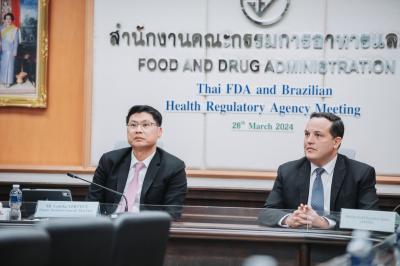
"PostToday spoke with Ms. Supattra Boonserm, Secretary-General of the Thai Food and Drug Administration (Thai FDA), who is directly responsible for overseeing Thailand’s ATMP regulatory system, to understand where the country stands today, what progress has already been made, and what lies ahead."
An End-to-End Regulatory System
ATMPs, or Advanced Therapy Medicinal Products, include cell therapy, gene therapy, tissue-engineered products, and combined ATMPs. A notable feature of Thailand’s approach is that the Thai FDA is not focusing only on the product itself, but is instead building a comprehensive regulatory system covering the entire process from upstream to downstream.
Ms. Supattra explained that the system is divided into three main parts. First, there is oversight of the product before it is authorized for use in humans. Second, there is regulation of manufacturing in laboratories, medical institutions, and medical schools to ensure compliance with Good Manufacturing Practice (GMP). Third, products intended for commercial sale must undergo registration as medicines with the Thai FDA before they may enter the market.
She emphasized that the system is designed to ensure quality, safety, and efficacy. In other words, the product must not only be safe to use, but must also work effectively and offer value for the money patients pay.
Sandbox and Ecosystem: Who Is in the Game?
One of the most important developments at present is the formation of an ATMP ecosystem in Thailand, bringing together medical schools, private companies, and hospitals.
On the academic side, several universities have entered the field in earnest as research institutions. Chulalongkorn University, for example, has already received certification for GMP for Clinical Research, making it the first officially certified ATMP research manufacturing site in Thailand. Meanwhile, Siriraj Hospital, Ramathibodi Hospital, and several other university-based institutions are in the process of applying for research-manufacturing licenses.
According to Ms. Supattra, Chulalongkorn University has become a model for other institutions by demonstrating how an ATMP research-manufacturing facility can be established in practice. Rather than having to look abroad, Thai stakeholders can now see that such a system can genuinely be built and operated in Thailand.
On the private-sector side, around ten companies have already obtained manufacturing licenses and are now upgrading their facilities to meet GMP standards in preparation for future commercial production.
The most closely watched mechanism, however, is the “Sandbox.” This framework allows medical schools that manufacture ATMPs to required standards to work with hospitals so that such products can be used in real patients within a research context. Examples include cooperation between Chulalongkorn University and Vachira Phuket Hospital, as well as healthcare facilities under the Department of Disease Control in Bang Rak.
Ms. Supattra noted that hospitals under the Ministry of Public Health, as well as private hospitals, are increasingly partnering with research and production units to carry out this work together.
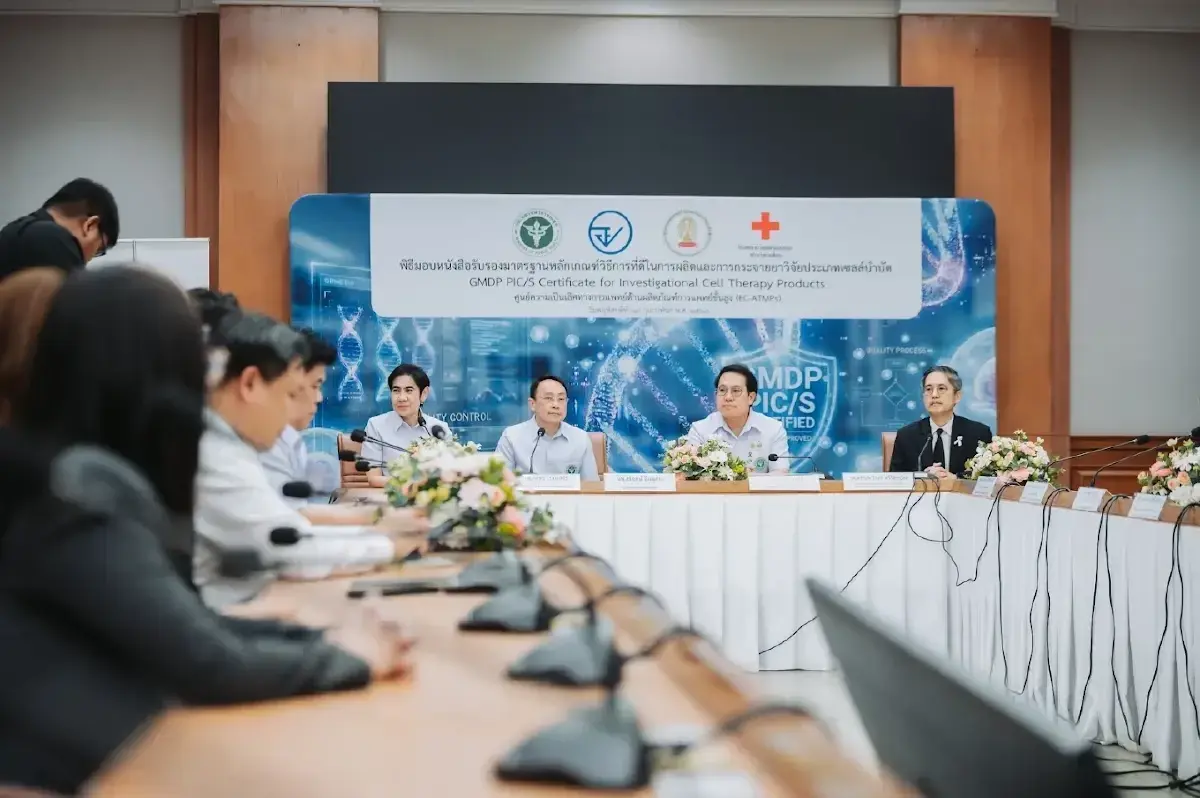
Most recently, the Faculty of Medicine, Chulalongkorn University received certification for Good Manufacturing and Distribution Practice (GMDP) for investigational cell therapy products in line with PIC/S standards. This reflects compliance with internationally recognized GMP and Good Distribution Practice (GDP) principles promoted by the Pharmaceutical Inspection Co-operation Scheme (PIC/S).
ATMPs Are Not Conventional Medicines
One of the most common misunderstandings in the health sector is the assumption that ATMPs can be assessed like ordinary medicines. Ms. Supattra explained that, because ATMPs involve cells and genes, their approval pathway is fundamentally different from that of chemical drugs.
Since these products are often manufactured for individual patients rather than in traditional factory-scale production, assessment of safety and efficacy must extend beyond the product itself to include the manufacturing site and production process. This is necessary to ensure that every product subsequently produced will maintain the same level of safety and efficacy.
She stressed that ATMPs are advanced therapies. To be used effectively in patients, they must undergo human studies and robust data collection. For products intended for commercial use, manufacturers must possess specialised technical knowledge, and their facilities must be capable of maintaining internationally accepted standards.
Another complex aspect is handling the product from the manufacturing site to the patient. Because cells and genes differ fundamentally from conventional chemical drugs, strict controls are needed for temperature, packaging, and pre-administration procedures in order to ensure that the product remains safe and viable when it reaches the patient.
Countdown to the First Commercial Thai-Made ATMP
Ms. Supattra revealed that a Thai private company is currently conducting Phase 2 clinical research and aims to launch the first commercially available ATMP developed by Thai experts within 2026.
The company is focusing on gene therapy for cancer. It has already completed Phase 1 and is now moving through Phase 2. The effort is being carried out through cooperation between the private sector and medical schools, as clinical research requires hospitals to participate in patient enrolment and case collection.
At the same time, human studies are already under way at several institutions, including Chulalongkorn University, Ramathibodi Hospital, and Siriraj Hospital, in order to generate the data needed for registration or future commercial production.
In terms of cost, Ms. Supattra acknowledged that one imported ATMP has already been registered by the Thai FDA, but its price is more than 60 million baht per dose because it is a new technology and is produced for an individual patient. She added that if Thailand can manufacture such products domestically and eventually move toward larger-scale production, costs could decrease significantly.
At present, most ATMPs remain highly personalized and are developed specifically for each patient, which keeps costs extremely high. Looking further ahead, however, she said the future may include “off-the-shelf” ATMPs that function more like conventional medicines and can be produced at greater volume, thereby reducing costs as technology continues to advance.
A Strategic Opportunity for Thailand
Beyond the clinical dimension, Ms. Supattra views ATMPs as a major economic opportunity that could help Thailand move decisively toward becoming a true medical hub. Thailand is already well known for medical services, and if advanced medical technologies can be added to that strength, the country may be able to attract foreign patients who cannot be treated elsewhere.
She described ATMPs as a source of hope for the country. If Thailand succeeds, it will reduce dependence on imported medicines and support more precise treatment tailored to individual patients. Although initial costs may be considerable, success in certain diseases could deliver enormous benefits to patients.
At the regional level, she noted that Thailand may still have an opportunity to move ahead of neighboring countries such as Viet Nam and Malaysia, which are also working to develop this field. She reaffirmed that the Ministry of Public Health, medical schools, and the private sector are all making serious efforts to position Thailand as an ATMP medical hub.
Thai FDA’s Role: From Regulator to Facilitator
When asked about criticism that obtaining Thai FDA approval is often difficult, Ms. Supattra rejected the claim. She said the Thai FDA operates according to international standards and is not slower than foreign regulators in approving products.
She explained that the agency’s current policy is to engage with stakeholders from the very beginning, helping them avoid mistakes and proceed in the right direction. In many cases, problems arise because developers move ahead without prior guidance and later have to come back to correct the process.
More importantly, she said the Thai FDA is now clearly moving beyond the role of a regulator alone. It is also prepared to act as a supporter and facilitator for those entering the ATMP field, whether they are medical schools, private companies, or foreign investors seeking to collaborate with Thai partners.
****************************************
Publication date 9 March 2026
Source: Adapted and translated from the original Thai article published in PostToday.